Blockchain - Development

Enterprise Blockchain Architectures

Designing distributed ledger solutions means aligning the right cloud provider with the operational and compliance demands of the systems you are building. Below are three production-grade blockchain projects spanning AWS, GCP, and Azure — focused on financial market technologies, valuation, and strict governance.

Let's talk
Project 1 • AWS

Tokenized Bond Trading & Settlement

Reducing settlement times and counterparty risk in fixed-income markets by representing bonds as digital tokens on a permissioned network.
AWS tokenized bond trading architecture
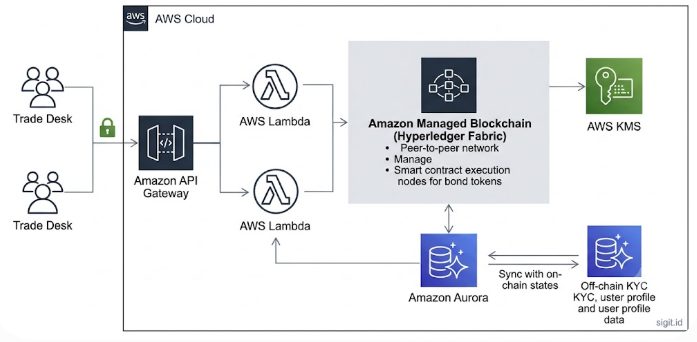
Trade flow from the external trade desk through API Gateway and AWS KMS into the core ledger on Amazon Managed Blockchain, with off-chain data synchronized to Aurora.
Architecture
  • Amazon Managed Blockchain (AMB) — private Ethereum network or Hyperledger Fabric as the core ledger.
  • AWS KMS — secure private-key handling for signing high-value bond transactions and enforcing institutional custody rules.
  • API Gateway & Lambda — secure REST APIs connecting trading front-ends to the smart contracts.
  • Amazon Aurora — off-chain database mapping user identities and KYC data to on-chain wallet addresses.
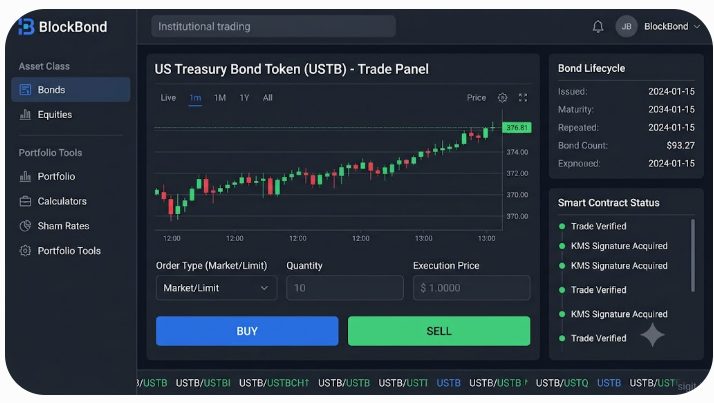
BlockBond trading platform UI
The 'BlockBond' trading platform: institutional dark-mode UI with live market data for a US Treasury Bond Token (USTB) pair and integrated smart-contract status updates.
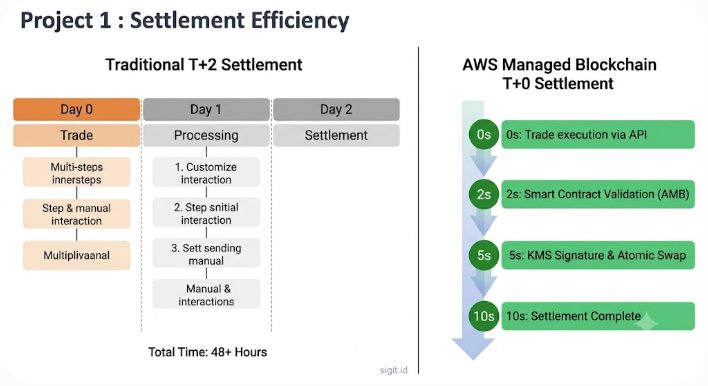
T+2 vs T+0 settlement comparison dashboard
Outcome dashboard: from the traditional T+2 settlement cycle (48+ hours) to near-instantaneous T+0 — completed in ~10 seconds via automated smart-contract execution.
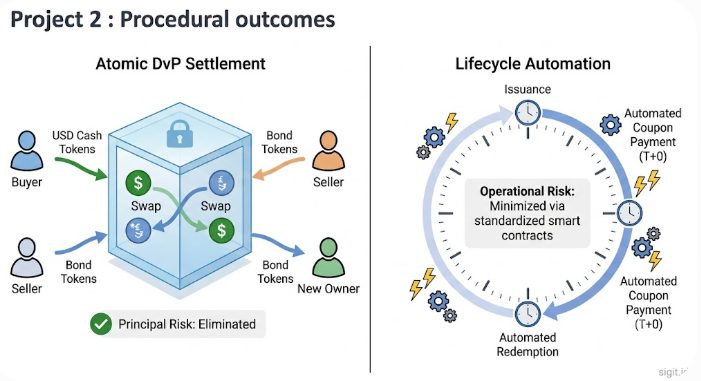
Atomic DvP and lifecycle automation
Atomic Delivery-vs-Payment in smart-contract escrow eliminates counterparty principal risk; the full bond lifecycle (issuance, coupons, redemption) runs automatically.
Outcome: automated coupon payments and standardized lifecycle management of bond issuances through smart contracts — near-instant settlement, minimal manual errors, and eliminated counterparty principal risk.
Project 2 • Google Cloud

Real-Time Securities Valuation Oracle

Accurate pricing data is critical for any automated financial system. This institutional-grade data oracle securely feeds real-world securities valuations into multiple blockchain networks.

Architecture
  • QuickNode on Google Cloud — resilient RPC infrastructure for the oracle's on-chain delivery.
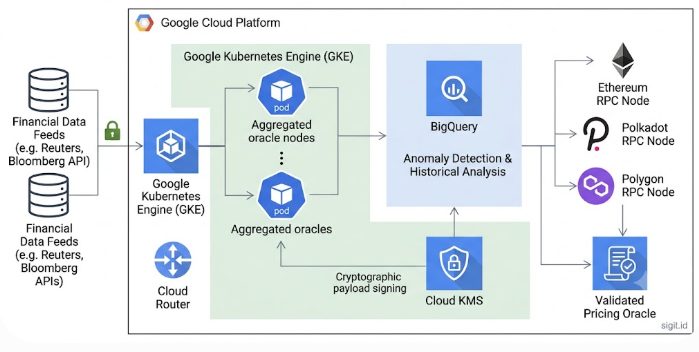
  • Google Kubernetes Engine (GKE) — highly available, containerized oracle nodes aggregating pricing data from traditional market endpoints.
  • BigQuery — massive-scale analysis of historical on-chain data alongside off-chain market feeds, detecting pricing anomalies before broadcast.
  • Cloud KMS — cryptographic signing of valuation payloads before on-chain submission.
GCP valuation oracle architecture
Market data feeds enter GKE-hosted oracle nodes, are validated in BigQuery, signed with Cloud KMS, and pushed via RPC to Ethereum, Polkadot, and Polygon.
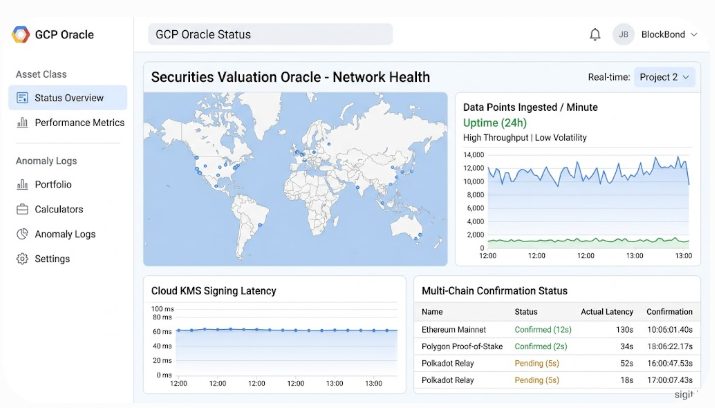
GCP oracle status monitoring dashboard
The 'GCP Oracle Status' monitoring dashboard: global ingestion points, data points ingested per minute, KMS signing latency, and per-network propagation status against institutional SLAs.
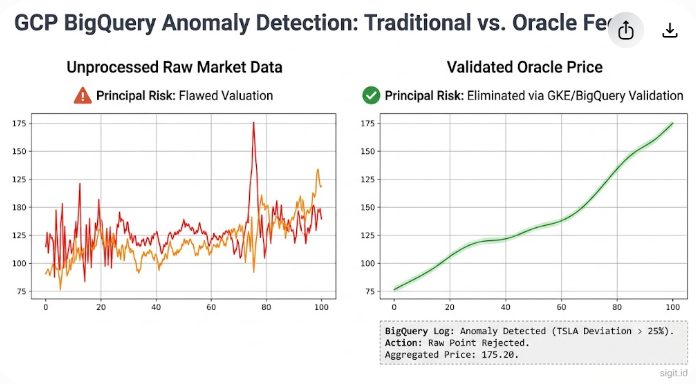
BigQuery anomaly detection outcome
Risk mitigation in action: BigQuery identifies and rejects a severe outlier in the raw feed, so smart contracts only ever consume the clean, validated oracle price.
Outcome: a tamper-proof, highly resilient pricing feed for smart contracts executing automated trades or calculating portfolio margins — with anomalies caught before they can cause flawed valuations.
Project 3 • Azure

Confidential Financial Ledger with IT Governance

Secure, verifiable record-keeping for inter-organizational financial reconciliation — deployed under a strict Information Security Management System aligned with ISO 27001.
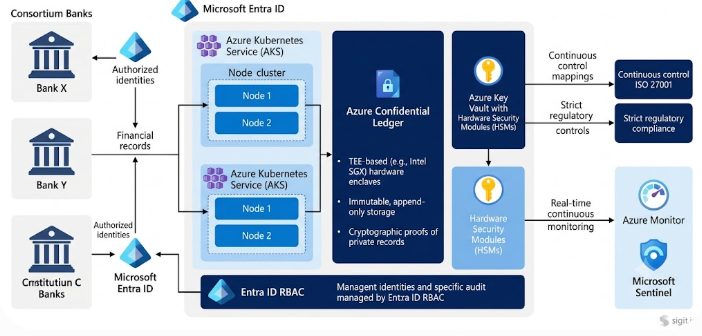
Azure confidential ledger architecture
Azure Confidential Ledger at the core of an institutional consortium: hardware-based Trusted Execution Environments in AKS store immutable records that produce cryptographic proofs without exposing the confidential payload.
Architecture
  • Kaleido on Azure / Azure Confidential Ledger — managed enterprise Web3 platform as the append-only core.
  • Microsoft Entra ID — strict Role-Based Access Control mapped to governance roles such as 'Consortium Auditor'.
  • Azure Monitor & Microsoft Sentinel — continuous audit logging and anomaly detection, mapping directly to ISO 27001 continuous-monitoring controls.
  • Azure Key Vault — dedicated Hardware Security Modules managing the consortium's cryptographic keys.
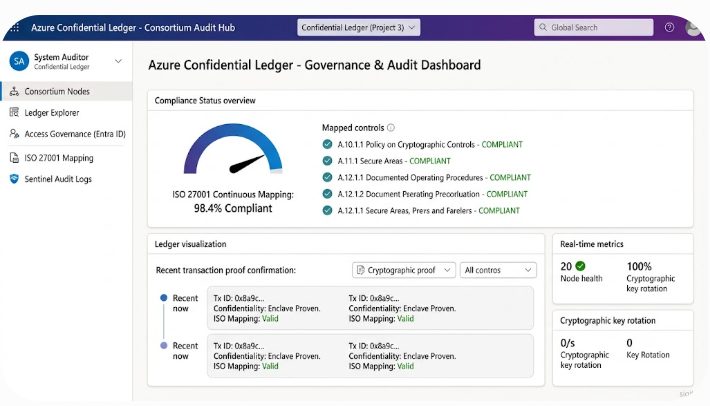
Consortium audit hub dashboard
The 'Consortium Audit Hub': an ISO 27001 continuous-mapping gauge (98.4% compliance) and cryptographic proof visualizer — validating on-chain records while transaction details stay inside the enclave.
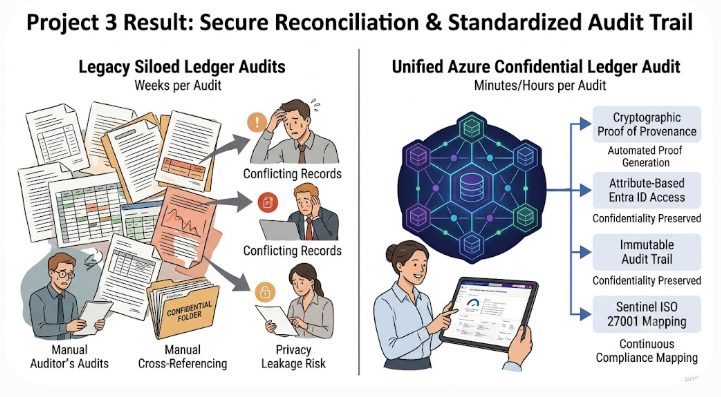
Legacy vs modern audit trail comparison
From weeks of manually cross-referencing siloed spreadsheets to minutes: auditors generate definitive, cryptographically provable audit trails from a single interface.
Outcome: a robust, append-only audit trail for financial transactions that satisfies stringent regulatory requirements and simplifies infosec compliance audits — audit cycles measured in minutes, not weeks.

Ready to get started?

Enterprise blockchain solutions on AWS, GCP, and Azure — smart contracts, asset tokenization, data oracles, and confidential ledgers designed for financial-grade security and compliance.

Let's talk